
How to Build a Low-Risk Property Portfolio in Dubai
Dubai continues to attract investors from around the world due to its strong rental market, tax-efficient environment, and growing economy. However, while the opportunities are significant, every investment carries a degree of risk. Therefore, building a Low-Risk Property Portfolio Dubai investors can depend on requires careful planning, diversification, and a long-term strategy.
Rather than focusing solely on high returns, many successful investors prioritize stability, consistent rental income, and sustainable capital appreciation. As a result, a well-balanced portfolio can help reduce exposure to market fluctuations while supporting long-term wealth creation.
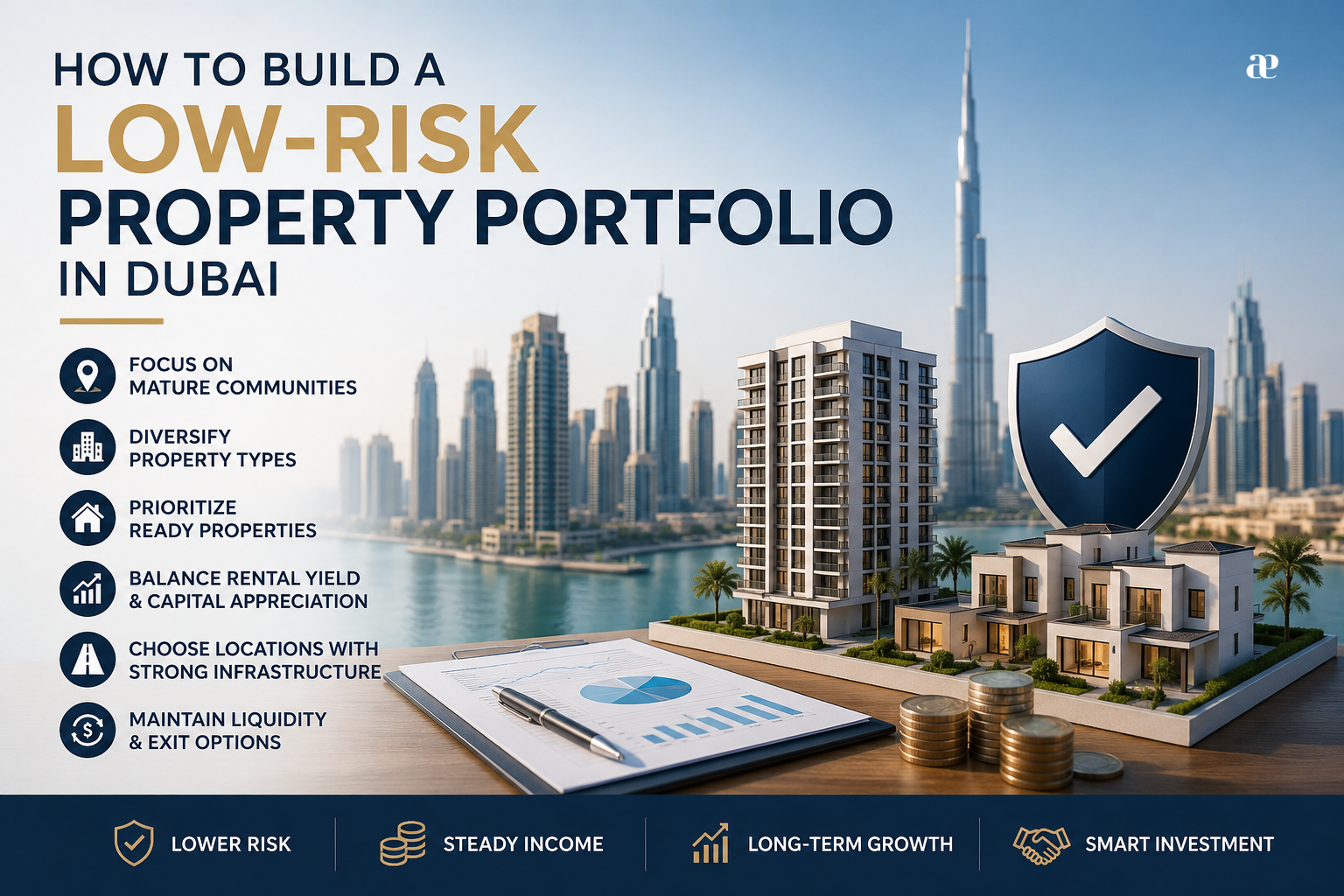
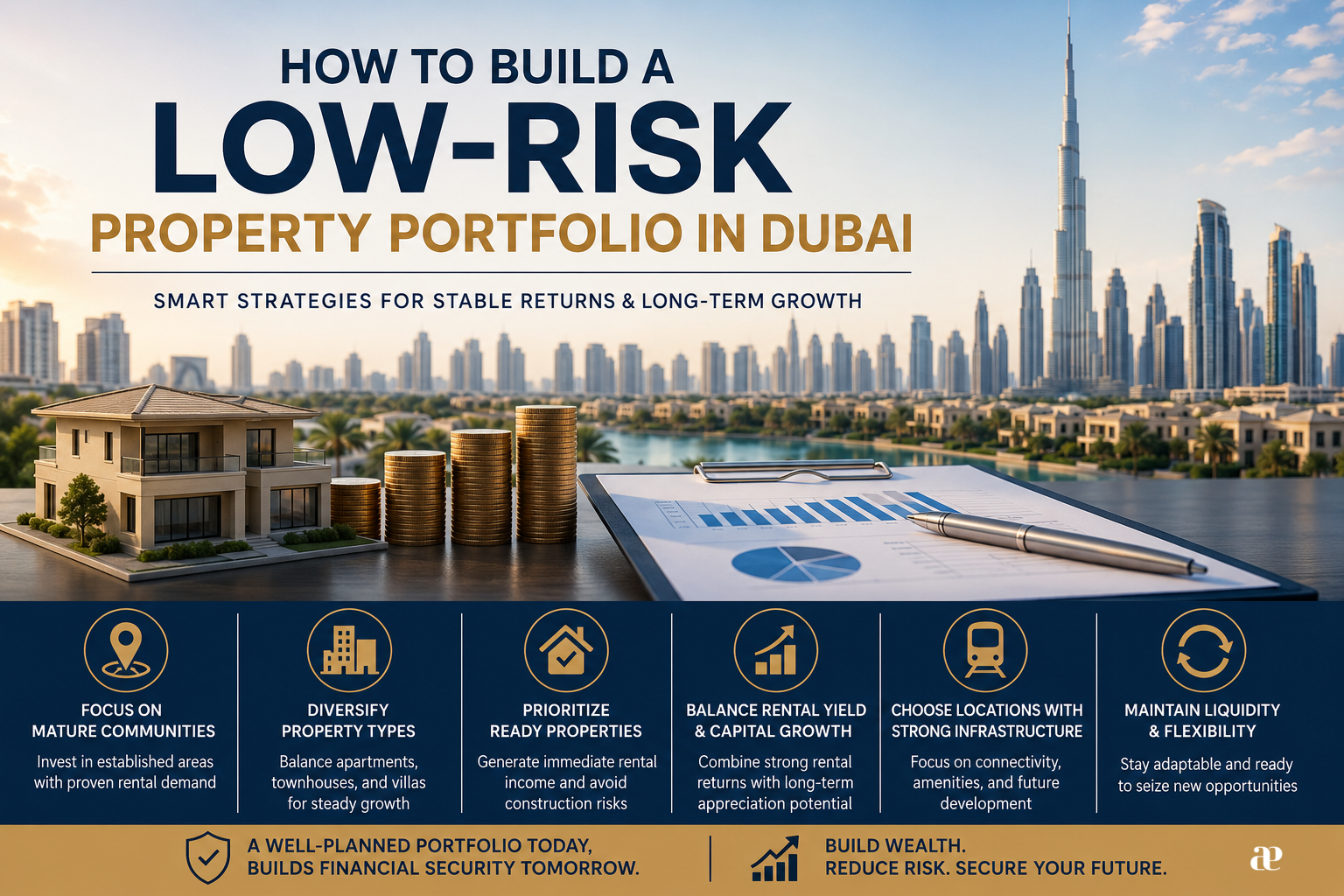
Focus on Mature Communities
One of the most effective ways to reduce investment risk is to focus on established communities with proven performance. Areas such as Dubai Marina, Arabian Ranches, and Jumeirah Village Circle (JVC) have demonstrated strong rental demand over many years.
Moreover, mature communities typically offer completed infrastructure, established amenities, and a larger tenant pool. Consequently, vacancy risks are often lower compared to newly launched developments. Investors seeking growth opportunities may also find our guide on Dubai Investment Hotspots 2026: 5 Communities to Watch useful when evaluating emerging and established locations.
Diversify Property Types
Diversification remains one of the most important principles of risk management. Instead of investing in a single property type, consider a mix of apartments, townhouses, and villas.
For example, apartments in central locations often generate attractive rental yields, while villas and townhouses may offer stronger long-term capital appreciation. By spreading investments across different property types, investors can reduce reliance on a single market segment.
Prioritize Ready-to-Move-In Properties
Ready properties can play an important role in a Low-Risk Property Portfolio Dubai strategy. Unlike off-plan investments, ready units provide immediate rental income and allow investors to inspect the property before purchase.
Additionally, construction delays and development risks are avoided. According to the Dubai Land Department (DLD), Dubai continues to enhance transparency and investor protection across the real estate sector, further supporting confidence in the market.
Balance Rental Yield and Capital Appreciation
A successful portfolio should not focus exclusively on rental income or capital growth. Instead, both factors should be carefully balanced.
Properties with strong rental demand can provide consistent cash flow, while properties in strategic growth areas may offer future appreciation potential. Therefore, combining both approaches can help create a more resilient investment portfolio.
Choose Locations with Strong Infrastructure
Infrastructure remains one of the strongest drivers of property value. Communities located near metro stations, major highways, schools, hospitals, and retail destinations often attract stronger tenant demand.
Furthermore, areas benefiting from new transportation and infrastructure projects may experience increased property values over time. Investors can learn more in our article on How Does Living Near the Dubai Metro Impact Property Values?
Dubai’s long-term growth strategy under the Dubai 2040 Urban Master Plan continues to support sustainable urban expansion and improved connectivity across the emirate.
Maintain Liquidity and Flexibility
Finally, investors should prioritize properties that can be easily rented or resold when required. Maintaining liquidity allows investors to adapt to changing market conditions and take advantage of future opportunities.
In addition, avoiding overconcentration in a single community or property type can improve portfolio resilience. A diversified approach often provides greater flexibility during market cycles.
Conclusion
Building a Low-Risk Property Portfolio Dubai investors can trust requires more than simply choosing popular properties. Instead, success is often achieved through careful diversification, investment in mature communities, selection of ready properties, and a focus on infrastructure-driven locations.
By balancing rental yields with capital appreciation and maintaining flexibility within the portfolio, investors can reduce risk while positioning themselves for sustainable long-term growth. As Dubai’s real estate market continues to mature, a disciplined investment strategy remains one of the most effective ways to achieve stable income and lasting value.