

Dubai Myths Foreigners Believe: 10 Common Misconceptions
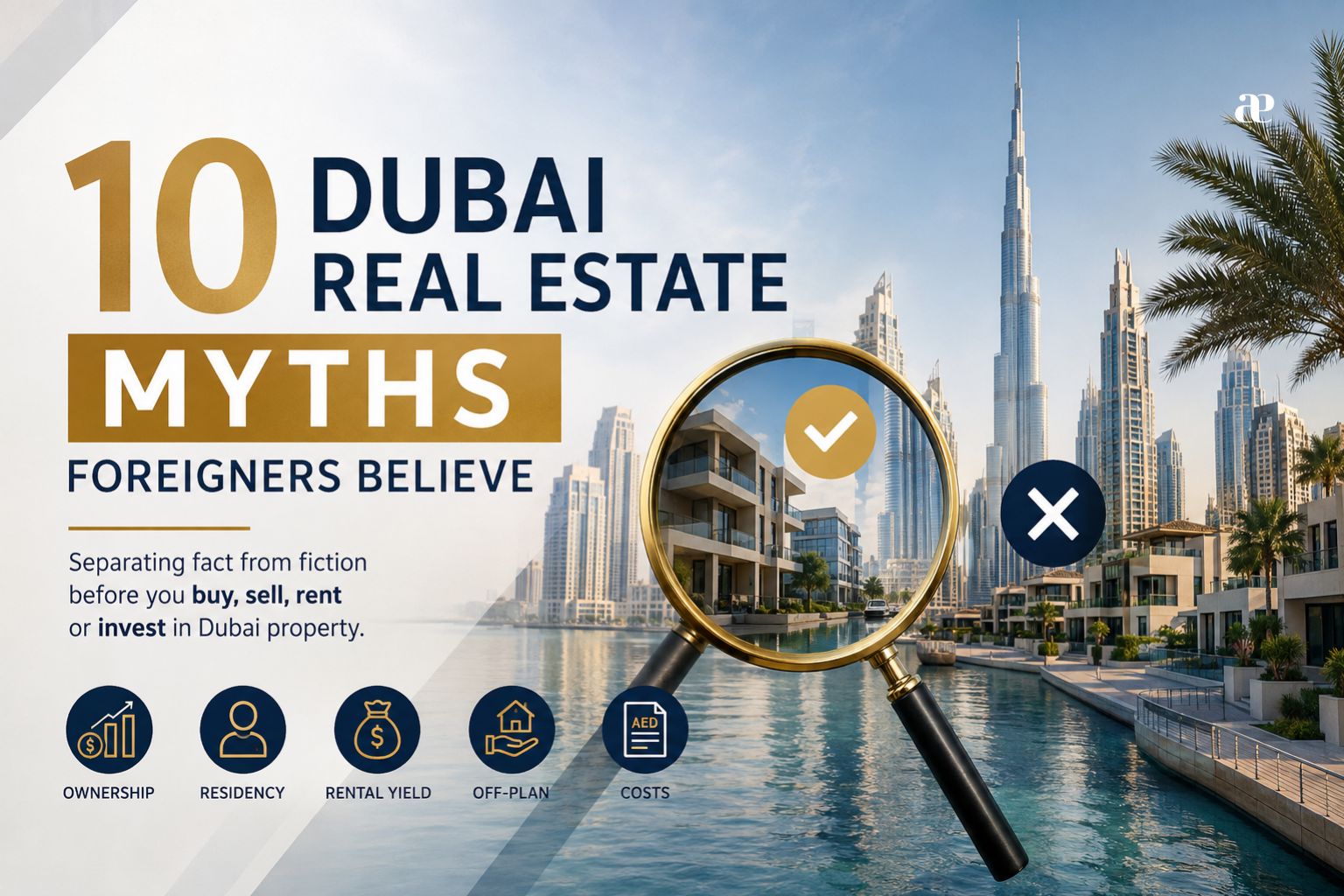
Dubai Real Estate Myths: Separating Fact from Fiction
Dubai has become one of the world’s most internationally recognised real estate markets. From luxury apartments in Downtown Dubai to waterfront villas and emerging communities, the city offers a wide range of opportunities for buyers and investors.
However, international interest has also created plenty of misconceptions.
Some foreigners believe property in Dubai is only affordable for the wealthy. Others assume every property generates high rental returns or that buying off-plan property is automatically risky. In reality, Dubai’s real estate market is much more diverse and regulated than many people realise.
So, before making a property decision, it is important to separate facts from assumptions.

Here are 10 Dubai real estate myths foreigners believe – and what you should actually know.
1. Myth: Foreigners Cannot Own Property in Dubai
This is perhaps the most common misconception.
The reality: Foreign nationals can own property in Dubai in areas designated for foreign ownership, including freehold areas. The UAE Government confirms that both UAE residents and non-residents can acquire freehold ownership rights in designated areas of Dubai.
Therefore, international buyers do not necessarily need to become UAE residents before purchasing eligible property.
However, ownership rights depend on the location and type of property. Consequently, buyers should verify the property’s ownership status before committing to a transaction.
For more information, refer to the Dubai Land Department’s real estate legislation.
2. Myth: You Need to Be a UAE Resident to Buy Property
Another common assumption is that foreigners must have a UAE residence visa before purchasing property.
The reality: Non-resident foreigners can purchase eligible freehold property in Dubai. The UAE Government specifically states that foreigners who do not live in the UAE may acquire freehold ownership rights in designated areas.
This is one reason Dubai attracts international investors from markets across the world.
Nevertheless, buying property and obtaining residency are separate matters. A buyer should not assume that purchasing any property automatically provides residency benefits.
Therefore, international investors should consider property ownership and residency requirements as two separate aspects of their investment strategy.
3. Myth: Every Dubai Property Is Extremely Expensive
Dubai is famous for luxury penthouses, branded residences and waterfront villas. However, the market is not limited to ultra-luxury properties.
The city offers apartments, townhouses and villas across a wide range of communities and price points.
For example, emerging areas can offer lower entry prices than established prime locations. As a result, investors with different budgets can explore different segments of the market.
Moreover, the right property should not necessarily be the cheapest one available.
Instead, buyers should consider location, connectivity, developer reputation, property quality, service charges, rental demand and future development.
If you are comparing communities, our guide to Dubai Investment Hotspots 2026 can help you understand some of the locations attracting investor attention.
4. Myth: Every Dubai Property Guarantees High Rental Returns
Dubai’s rental market is attractive to many investors, but no property investment should be described as guaranteed.
Rental performance can vary significantly depending on the community, property type, size, condition, furnishing, purchase price and tenant demand.
For instance, a smaller apartment in a well-connected rental market may perform differently from a large villa in a community with a different tenant profile.
Therefore, investors should calculate potential rental yield rather than simply assuming that every Dubai property will generate high returns.
It is also important to account for service charges, maintenance, vacancy periods, management costs and other expenses when estimating net returns.
In other words, gross rental yield is only one part of the investment equation.
5. Myth: Buying Off-Plan Property Is Always Risky
Off-plan property is sometimes viewed as inherently risky because the buyer is purchasing a property before completion.
However, this does not mean every off-plan investment is high-risk.
Dubai’s off-plan sector operates within a regulatory framework, and buyers should understand the project’s registration, developer credentials, payment structure and contractual terms before investing.
The Dubai Land Department also provides extensive real estate legislation and regulatory information for the market. You can review the official DLD legislation here.
Furthermore, off-plan properties can offer advantages such as staged payment plans and access to new developments.
Nevertheless, investors should conduct due diligence instead of choosing a project solely because of a promotional offer or attractive payment plan.
6. Myth: You Can Buy Any Property and Resell It Quickly for a Profit
Dubai’s strong property market can create the impression that every property can be bought and resold immediately at a higher price.
That is not necessarily the case.
Property values can be influenced by supply, demand, location, developer reputation, property condition, market cycles and the wider economy.
Additionally, buying and selling involves transaction costs. According to the Dubai Land Department’s current property sale registration information, the listed sale registration fees include charges for both buyer and seller, along with additional title deed and service-related fees.
Consequently, investors should calculate their total acquisition and exit costs before assuming a short-term profit.
Long-term investment strategies may sometimes be more appropriate than relying entirely on quick resale opportunities.
7. Myth: Location Does Not Matter Because Dubai Is Well Connected
Dubai’s infrastructure is extensive, but location remains one of the most important factors in real estate.
Properties close to major business districts, transport links, schools, retail destinations, beaches and lifestyle attractions can appeal to different categories of buyers and tenants.
For example, a property aimed at professionals may benefit from proximity to business hubs and public transport, while a family-oriented property may gain from nearby schools, parks and community facilities.
Therefore, “Dubai” should never be treated as one single property market.
Each community has its own characteristics, supply levels, tenant demographics and investment profile.
That is why comparing areas before buying is essential.
8. Myth: Dubai Property Has No Additional Costs
The phrase “tax-friendly property market” sometimes leads international buyers to believe that the purchase price is the only major expense.
In reality, buyers should budget for transaction and ownership-related costs.
Depending on the transaction, these can include registration fees, title deed-related charges, service charges, mortgage-related costs, agency fees and property maintenance expenses.
For example, the Dubai Land Department’s current property sale registration service lists additional charges beyond the basic sale registration fee.
Therefore, an investor should calculate the total cost of acquisition, rather than comparing properties based only on their advertised selling price.
This approach provides a more realistic picture of the property’s potential return.
9. Myth: All Freehold Properties Are the Same
Another misconception is that “freehold” automatically means every property offers the same ownership rights and investment characteristics.
The reality is more nuanced.
Freehold refers to an ownership structure, but the investment itself can differ considerably based on location, building, developer, property type and market demand.
The Dubai Land Department explains that foreign ownership is permitted in designated freehold areas.
However, investors still need to investigate the individual property.
For example, two freehold apartments in different communities can have very different rental demand, service charges, resale prospects and capital-growth potential.
Thus, freehold status is important, but it should never be the only factor guiding an investment decision.
10. Myth: You Need Millions of Dirhams to Enter Dubai’s Property Market
Dubai’s luxury real estate market is highly visible, which can make the entire market appear inaccessible to average investors.
However, Dubai offers a broad range of residential properties and investment opportunities.
In fact, Dubai Land Department’s First-Time Home Buyer Programme is designed to make homeownership more accessible to eligible UAE residents across nationalities and income levels.
Moreover, buyers can explore different property types, communities and payment structures depending on their financial position.
Therefore, the more useful question is not “Can I afford Dubai property?” but “Which Dubai property fits my budget, objectives and investment strategy?”
Why Understanding Dubai Real Estate Myths Matters
Real estate is a significant financial decision, particularly for international buyers who may be unfamiliar with Dubai’s regulations and market structure.
Consequently, relying on social media claims, sales pitches or assumptions can lead to unrealistic expectations.
Instead, buyers should research:
- Property ownership regulations
- Community fundamentals
- Developer reputation
- Rental demand
- Service charges
- Payment plans
- Transaction costs
- Resale potential
- Expected holding period
- Overall investment objectives
Additionally, buyers should verify important regulatory information through official sources such as the Dubai Land Department and the UAE Government portal.
Final Thoughts
Dubai’s real estate market offers opportunities for both local and international buyers. However, successful property investment is not based on myths, hype or assumptions. It is based on research, due diligence and understanding the fundamentals of each property and community.
From foreign ownership and off-plan projects to rental yields and transaction costs, knowing the facts can help investors make more informed decisions.
Ultimately, Dubai property can offer compelling opportunities – but the right investment depends on choosing the right property, location, strategy and timing.
If you are considering buying or investing in Dubai real estate, explore the Area Experts real estate blog for more insights into Dubai communities, property trends and investment opportunities.
Disclaimer: Real estate regulations, fees and market conditions can change. Buyers should verify current requirements with the relevant authorities and obtain professional advice before making an investment decision.